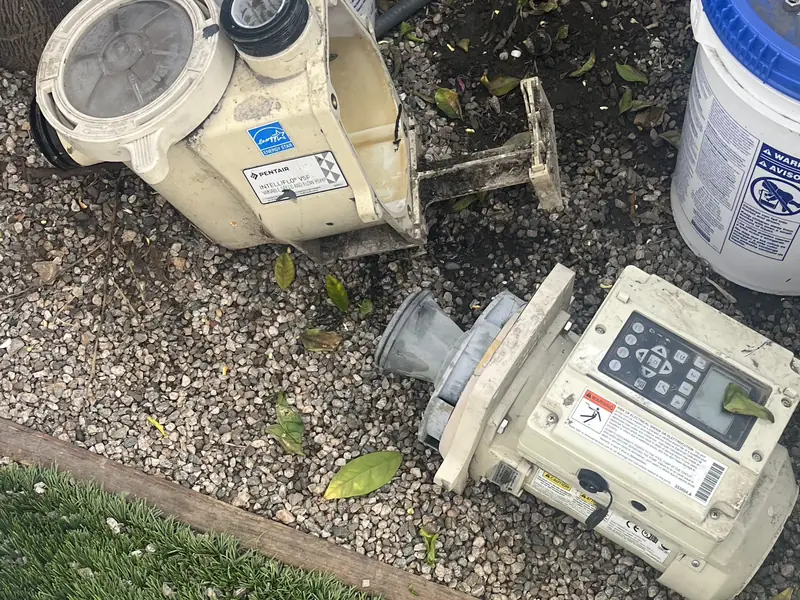
Your pool pump is the heart of your pool. When it stops, the water stops moving, and a clear pool can turn green within days. The good news is that a broken pool pump doesn't always mean buying a new one. Here are the warning signs, what you can safely check yourself, and the exact steps we follow on a swimming pool pump repair call.
Signs Your Pool Pump Needs Repair
Most pump problems show up in one of five ways. Knowing which one you have makes the repair faster.
- It won't turn on. Power isn't reaching the motor, the capacitor has failed, or the motor is worn out.
- It hums but won't start. The motor is getting power but can't spin. A bad capacitor or a jammed impeller is the usual cause.
- It's leaking. Water under the pump usually points to a worn seal or o-ring.
- It's loud or screeching. That high-pitched sound is typically worn motor bearings.
- It won't prime. The pump runs but doesn't pull water, usually because air is getting in or water can't reach it.
What You Can Safely Check Before You Call
Some pump problems have simple causes. Turn the pump off first, then check these four things.
- Water level. It should sit about halfway up the skimmer opening. Any lower and the pump pulls in air.
- Baskets. Empty the skimmer basket and the pump basket. A packed basket starves the pump of water.
- Lid o-ring. Make sure the o-ring under the pump lid is clean, seated flat, and not cracked.
- Timer. Confirm the timer or automation is actually set to run.
Stop there. Don't open the motor or touch the wiring. Pool pumps run on high voltage, and a capacitor can hold a charge even with the power off. Anything electrical is a job for a professional.
How We Handle a Swimming Pool Pump Repair
Every pump call follows the same seven steps. The order matters, because it keeps us from replacing a part that was never the problem.
Ask what the pump is doing
Silent, humming, loud, leaking, or not priming. Each symptom points to a different part of the pump, so your description tells us where to look first.
Shut off power at the breaker
Before anyone puts hands on the pump, the power goes off at the breaker. No exceptions.
Confirm power is reaching the pump
We check the timer or automation, inspect the wiring connections, and test the voltage at the motor. A pump that looks dead is sometimes a pump that isn't getting power.
Rule out the simple stuff
Pump basket, lid o-ring, water level, and air leaks. These cause a lot of priming problems, and they're quick to fix.
Open up the motor
We test the capacitor, check that the shaft spins freely, and look over the impeller, the seal, and the bearings.
Give you an honest quote
We weigh the pump's age and condition, then tell you plainly whether a repair or a replacement makes more sense.
Repair it and test it
We make the repair, put the pump back together, prime it, and run it. We don't leave until it's moving water and there are no leaks.
The Pool Pump Repairs We Do Most
Four fixes cover most of the pump calls we get.
Capacitor. The capacitor gives the motor the jolt it needs to start. When it fails, the pump hums or does nothing at all.
O-ring. O-rings dry out and crack over time. A bad one lets air in or water out, which leads to priming problems and leaks.
Motor. When the motor itself has worn out, we replace it.
Rewiring. Years of sun and heat take a toll on wiring and connections. Sometimes the pump is fine and the wiring feeding it is the problem.
When Replacing the Pump Is the Smarter Move
Our rule of thumb is simple. If a pump is older than 6 to 8 years, replacing it is usually smarter than repairing it.
A repair on an old pump is a short term fix. Once one part wears out, the others are rarely far behind, so you pay for a repair and then another piece fails. A new pump comes with a warranty. A repaired old pump doesn't.
On a newer pump, a small part like a capacitor or an o-ring is often all it takes.
A client's pump wouldn't turn on, and they wanted to know what a repair would cost. A repair was clearly cheaper than a new pump. Once we opened it up, we found two problems. The capacitor was failing, and the motor had two years left at best. We didn't charge for the repair attempt, so that money could go toward a new pump instead.
When a replacement is the right call, we install Pentair, Jandy, and Hayward. Those are the only three brands we use.
Need a Pool Pump Looked At?
If your pool pump is acting up, give GK Swimming Pools a call. We're a family-run company, three generations in, and we handle swimming pool repair throughout the San Fernando Valley and Santa Clarita. We'll tell you what's wrong and whether a repair or a replacement makes more sense for your pump.